Pairing a Queue Management System in Saudi Arabia With Biometric Check-In
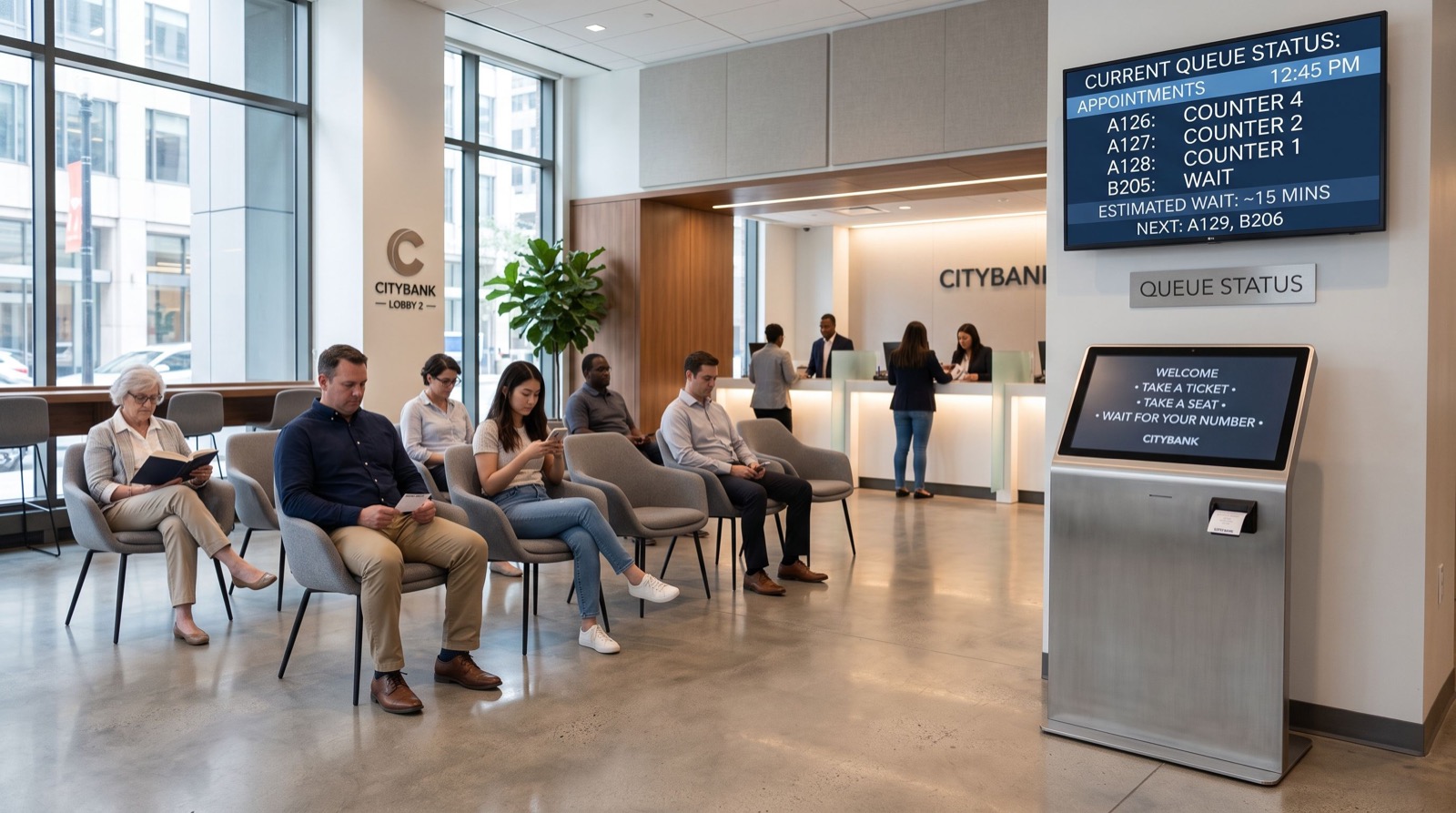
Service centers across the Kingdom, from clinics and banks to government one-stop shops, share a common challenge: verifying who a visitor is while keeping the line moving. The answer that leading operators have landed on is a combination of a smart queue management system in saudi arabia and secure biometric check-in. Within the first minute of arrival, a visitor can confirm their identity with a fingerprint, join the correct queue, and receive an accurate wait estimate, all without paperwork. This guide explains how that pairing works and why it is spreading fast across the GCC in 2026.
Unlike a simple ticket dispenser, this approach ties each person in line to a verified identity. That unlocks personalized service, tighter security, and cleaner data, three things every regulated industry in Saudi Arabia now demands.
Why Combine Queuing With Biometrics?
Traditional queues treat everyone as an anonymous number. That works for a coffee shop, but not for a bank branch handling account changes or a hospital pulling up patient records. When identity verification and queuing are separate steps, visitors wait twice: once to prove who they are, and again to be served.
Merging the two collapses that friction. A fingerprint scan at the kiosk both authenticates the visitor and places them in the right queue with their profile already loaded. When the agent calls the ticket, the customer’s details are on screen, ready to go. The result is faster service, fewer errors, and a strong audit trail.
Where this combination shines
- Bank and finance branches handling sensitive transactions
- Healthcare clinics matching patients to records instantly
- Government service centers verifying national identity
- Telecom stores confirming subscriber identity for SIM issuance
- Corporate reception desks managing visitor access
The Role of Reliable Biometric Hardware
Software promises mean nothing without dependable capture at the counter. Fingerprint accuracy, speed, and durability determine whether the whole experience feels effortless or frustrating. A proven Biometric Device reads prints in a fraction of a second, tolerates the wear of thousands of daily touches, and integrates cleanly with queue software and identity databases.
Choosing the right unit is where sourcing from reliable local experts pays off. They understand Saudi compliance requirements, provide Arabic-ready deployment, and ensure the scanners talk to your existing systems without costly custom development.
Measurable Impact Across the Visit
What does the combined approach deliver in practice? The table below contrasts a conventional split process with an integrated biometric queue flow.
| Stage | Separate Steps | Integrated Flow |
|---|---|---|
| Identity verification | Manual, at counter | Instant, at kiosk |
| Average check-in time | 3-4 minutes | Under 20 seconds |
| Record-matching errors | Frequent | Near zero |
| Audit trail quality | Partial | Complete |
The productivity gains compound. Agents spend their time on the actual service rather than on lookups and re-entry, and managers gain a verified, tamper-resistant log of every interaction.
Consider a busy bank branch in Riyadh during salary week. Under the old model, dozens of customers queued twice, first to prove identity and then again to reach a counter, creating visible frustration and pushing some to abandon the visit entirely. With an integrated biometric queue, the same customers authenticate in seconds at the kiosk, are automatically routed to the counter equipped for their transaction, and see an honest wait estimate on the display. Branch managers report that this transparency alone calms the floor, because uncertainty, not the wait itself, is what irritates most visitors. Over a full month, the compounded time savings free up staff hours that can be redirected toward advisory conversations, complaint resolution, and cross-selling, all of which lift both revenue and satisfaction scores in a measurable, reportable way.
Building the Deployment: Step by Step
A successful project follows a clear order. Rushing straight to a full rollout is the most common mistake.
- Map which services genuinely require identity verification.
- Select biometric hardware certified for your compliance needs.
- Integrate scanners with the queue platform and back-end records.
- Pilot in one branch, capturing consent and privacy notices clearly.
- Train staff on enrollment, exceptions, and fallback procedures.
- Scale once accuracy and consent workflows are proven.
A concrete tip that saves real headaches: always design a graceful fallback. Some visitors will have worn fingerprints or will decline biometric capture. A well-configured queue platform lets them check in with an ID document or phone number instead, so no one is ever turned away at the door.
Privacy, Consent, and Compliance
Biometric data is sensitive, and Saudi regulators treat it accordingly. The Kingdom’s Personal Data Protection Law sets clear rules on collecting and storing identifiers, and organizations should align with guidance from the Saudi Data and AI Authority. Best practice is to store templates rather than raw images, encrypt everything at rest and in transit, and capture explicit consent at enrollment.
Done correctly, biometrics can actually strengthen privacy by reducing the amount of paperwork floating around a branch. The national reform agenda outlined by the Vision 2030 program explicitly rewards secure, citizen-centric digital services, and a compliant biometric queue solution fits that vision neatly.
Frequently Asked Questions
Is a biometric queue management system in Saudi Arabia legal?
Yes, provided you comply with the Personal Data Protection Law: obtain explicit consent, store encrypted templates rather than raw prints, and give visitors a non-biometric alternative. A knowledgeable integrator will build these safeguards in from day one.
What happens if a fingerprint will not scan?
Good systems always include a fallback such as ID document entry or a mobile ticket. No visitor should ever be blocked from joining the queue because of a scanning issue.
How secure is the stored data?
Reputable deployments store mathematical templates, not fingerprint images, protected by strong encryption. Even if data were intercepted, it could not be reverse-engineered into a usable print.
Can this integrate with our existing records?
In most cases, yes. Modern biometric devices and queue platforms expose standard interfaces that connect to CRM, banking, or health-record systems, provided you work with an experienced local partner.
Conclusion
Combining a queue management system in Saudi Arabia with secure biometric check-in is one of the most practical upgrades a regulated service center can make in 2026. It shortens waits, eliminates identity friction, and produces the clean, verifiable data that regulators and executives both want. The key ingredients are dependable biometric hardware, a flexible queue platform, and a privacy-first design that always offers a fallback.
If your branches still handle identity checks on paper, the opportunity is significant and the technology is mature. Start with a single-branch pilot, get your consent workflows right, and let the data make the case for a wider rollout. Reach out to a trusted provider today and take the first step toward faster, safer, smarter service.